Key takeaways
- Four hours of driving per day is an upper limit, not a target.
- 200 to 250 kilometres (125-155 miles) is a realistic daily distance for most routes.
- A motorhome drives slower than maps suggest: bends, inclines, and wind have a big impact.
- Vehicles over 3,500 kg often face lower speed limits in many countries.
- Moving takes more time than just driving: setting up, packing up, services, and finding a spot all add up.
Ask the question in any motorhome forum, and the answer is always the same. The biggest mistake first-time motorhomers make? Trying to see too much.
This isn't just an opinion; it's the consensus of everyone who has made that mistake. The problem is, 'too much' isn't a number. And without a number, it's hard to know if your itinerary is realistic.
The Number
The most common rule of thumb is no more than four hours on the road per day. On most European roads, this translates to roughly 200 to 250 kilometres (125 to 155 miles).
Note the phrasing — this is an upper limit, not a target. A great day in a campervan is often one with just a hundred kilometres of driving.
Why Four Hours in a Motorhome is Different from Four in a Car
If you're new to this, you might think: four hours? That's nothing. A drive from Paris to Amsterdam takes about six.
The difference lies in the demands of driving. A motorhome—whether it's a panel van conversion or a large A-class—is tall, wide, and heavy. You feel crosswinds. You have to be mindful of every narrow passage, low-hanging branch, and tight roundabout. You can't merge into traffic quickly. When an oncoming truck passes you on a narrow road, your shoulders tense up in a way they don't in a passenger car.
It's draining. Especially if there's only one driver, which is often the case on motorhome trips as not everyone feels comfortable behind the wheel of a large vehicle.
Furthermore, the map can be deceiving. Route planners calculate speeds for cars. A motorhome is slower on inclines, in bends, and against the wind. You also stop more often—for coffee, a scenic view, fuel, or to top up water. Expect to add about twenty percent to the travel time your navigation system suggests.
In many countries, vehicles over 3,500 kg (approx. 7,700 lbs) have lower speed limits. In Croatia, for example, the motorway limit is 80 km/h instead of 130 km/h. This significantly changes your daily range. This 3,500 kg threshold is key for many European drivers with a standard Category B licence. UK drivers who passed their test before 1997 may have entitlements to drive heavier vehicles, but it's always wise to check your specific licence details.
What the Drive Doesn't Account For
Driving time is only part of the journey. A travel day also consists of: securing everything inside, disconnecting electricity, refilling fresh water, emptying waste water, and doing groceries. At the end of the day, you need to find a place to stay, which can easily take an hour in high season.
Add it all up, and a 'short drive of 250 kilometres' can fill an entire day. You've travelled, but you haven't travelled and seen something.
The Calculation People Make at Home
This is where it often goes wrong, and it's an understandable mistake. You have two weeks. Norway is vast. You want to see the fjords, the Lofoten Islands, and the city of Bergen. You plug it into a route planner, see that it's 'possible,' and you book your trip.
What the planner doesn't show is that it's only possible if you drive almost every single day. That you'll see the fjords from the road, not from a hiking trail. That you'll spend a day and a half on the Lofoten Islands for a fourteen-day trip.
The question isn't whether it fits. The question is whether you want your holiday to be like that.
What Does Work
Plan fewer destinations than you think you can manage. You'll naturally fill the spare time along the way. The reverse doesn't work.
Build in non-driving days. Two nights in the same spot means a full day without setting up or packing up. That's where the holiday feeling truly kicks in.
Alternate long and short driving days. A 300-kilometre drive is fine if the next day is only 60.
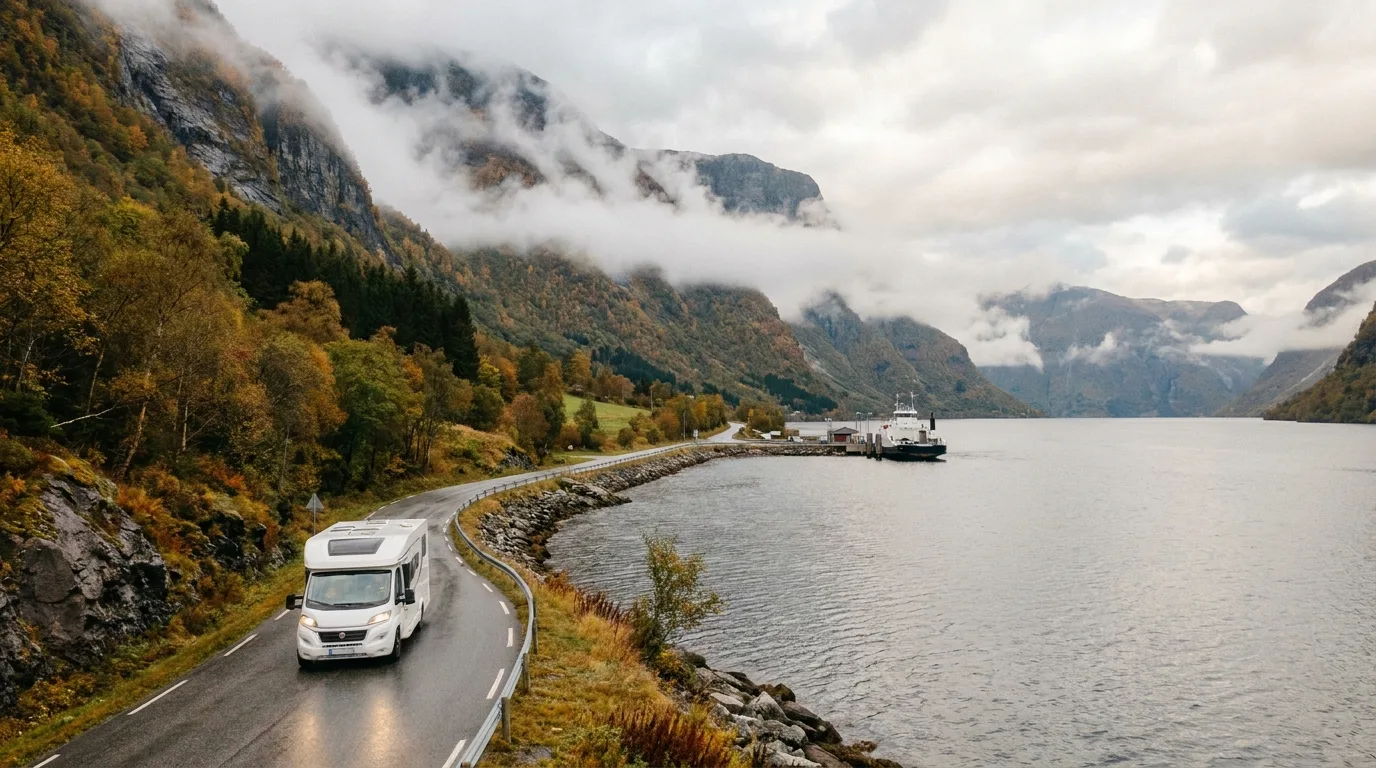
Consider the type of road. Two hundred kilometres on a German autobahn is not the same as 200 kilometres on a Norwegian fjord road. On the west coast of Norway, 150 kilometres can feel like 250 elsewhere—tunnels, toll booths, ferries, and winding roads all take time. Remember also that Norway, like Sweden and Denmark, has its own currency (the Krone), not the Euro.
Allow at least four days for a first trip. Anything shorter is hardly worth it; you need that time to find your rhythm.
The Inverse Rule
There's a phrase many motorhomers eventually come up with themselves, usually sometime during their second week: fewer kilometres equals more holiday.
It might sound like a cliché, but it's a practical planning rule. Every destination you cut from your itinerary gives you an afternoon back. And it's the afternoons—the chair outside, the unexpected trail, the village you just happened to stop in—that people talk about afterwards. Not the kilometres driven.
Where It Gets Tricky
The advice is simple. The execution is not. Because as soon as you get specific—these fourteen days, this starting point, these destinations—you need to know the actual driving time for each leg of the journey. And that is precisely what a map won't tell you.
Frequently asked questions
About the author

Co-founder of Camproads
Bas is co-founder of Camproads. He previously worked in the travel industry on rail and package holidays, and started Camproads on the conviction that a campervan trip deserves better planning than a list of sights. At Camproads he handles route research and the data behind it: which stages are actually drivable, where you may legally spend the night, and what a trip really costs. He prefers writing about what other articles skip.
Co-founder of Camproads · background in the travel industry · route planning and trip costs