Key takeaways
- On Norwegian toll roads and most ferries your number plate is read; don't count on being able to pay on board or at the roadside.
- With Epass24 (tolls) and FerryPay (ferries) you pay the full price with no extra costs.
- A toll tag with an AutoPASS agreement gives 20% off at most toll points and, with a prepayment, 50% off the ferries.
- You cannot get a toll tag for a motorhome up to 3,500 kg at the border: order it well before you leave.
- The ferry fare depends on your length including the bike rack: above 6 metres you pay more than double.
Your number plate is your ticket
On Norwegian toll roads you simply drive through, and on most car ferries you roll on deck without a ticket, because your number plate has already been read as you drive on. That makes for easy driving, but it does mean you don't sort out payment along the way. Paying by bank card on board is far from possible everywhere and never earns a discount, and cash is only accepted in Norway where staff are present. The old ferry cards are no longer valid.
Every vehicle pays tolls, so a foreign motorhome does too. If you arrange nothing, the owner of the motorhome gets an invoice afterwards: for the ferries at the full price with an invoice fee on top, and for the toll roads there may be extra costs because your number plate has to be looked up. For a German plate that is €5.10; the Netherlands and Belgium are not on the AutoPASS list (as of May 2025). Whatever you do, don't leave an invoice unpaid, because anyone who doesn't pay for a ferry can be charged a surcharge of NOK 2,350.
Three ways to pay
| What you arrange | Toll roads | Ferries |
|---|---|---|
| Nothing | Invoice afterwards, possibly with a lookup fee | Invoice at full price, plus an invoice fee |
| Epass24 and FerryPay | Full price, one invoice a month | Full price, charged automatically |
| Toll tag with an AutoPASS agreement | 20% off at most toll points | 10% off, or 50% with a prepayment |
Epass24 and FerryPay together are the simplest choice, and for most trips that is enough. With Epass24 you register your number plate for the toll roads: you get no discount, but you do get the rate that belongs to your motorhome, and the amounts arrive on one invoice a month. With FerryPay you link your number plate to your bank card, after which every crossing is charged automatically and the receipt comes by email.
A toll tag only works together with an agreement with AutoPASS. On the toll roads that saves 20% at most toll points. On the ferries the tag alone gives you 10% off, and if you also take out AutoPASS for ferje, an agreement where you pay in advance, you pay 50% less as a private customer. The prepayment is NOK 2,200 for a motorhome up to 8 metres (2026). Every crossing is deducted from it at the discounted price, and whatever you don't use is refunded when you end the agreement.
When should you get a toll tag?
There are two situations in which the tag is worth it.
The first is a route with many crossings. On our route From Fjord to Fjord, for example, you take seven ferries, and along the coast there can be more. Because the rest of the prepayment is refunded, the tag mainly costs you some preparation, and the more often you sail, the more the half price pays off.
The second is a motorhome that weighs more than 3,500 kg. You then only get the discount on the toll roads with both a toll tag and an agreement, and without those two you don't fall into the rate group for light vehicles either.
Order in good time, because this is where it often goes wrong. You cannot get a toll tag for a motorhome up to 3,500 kg at the border: you order it well before you leave and it arrives by post. Within Norway itself that already takes one to two weeks, so allow more for an address abroad. For heavier motorhomes AutoPASS lists pick-up points at customs stations and border ferries, but the tag only works once you have taken out the agreement.

Measure your motorhome with the bike rack on
What you pay on a ferry depends on the length measured on the quay or on board, and everything attached to the vehicle counts. The limit that matters is 6 metres. On a short crossing you pay NOK 51 up to 6 metres and NOK 117 from 6 to 8 metres, and on a longer one it is NOK 104 against NOK 231 (full price 2026, zone 1 and zone 10). With a motorhome of 6.7 metres you are therefore in the more expensive group, and a motorhome of 5.99 metres moves up a group with bikes on the back.
If the rack takes you over 8 metres, you pay the rate for 8 to 10 metres. For the discount you then also need the higher prepayment of NOK 10,600, because anyone who has paid for the group up to 8 metres and turns out to be longer gets no discount. So measure once, from the front bumper to the rearmost point of the rack.
Free ferries, and three you had better book
Not every crossing costs money. Small connections with fewer than 100,000 passengers a year, and ferries to islands without a fixed road link, are free, and on the other ferries the fare has been halved. The government has proposed keeping it that way in 2027; parliament decides on it in December 2026. Whether your ferry is free is shown per connection on autopassferje.no.
In summer there are queues for the busiest ferries. On three connections it is better to book a place in advance: Lauvvik–Lysebotn in the south-west, and Bognes–Lødingen and Bodø–Moskenes on the way to the Lofoten Islands. On Bodø–Moskenes part of the capacity can be reserved up to ten hours before departure, and the rest goes on a first-come, first-served basis. The Geiranger–Hellesylt ferry is not sailing until further notice (as of November 2026).
Renting a motorhome?
The invoice goes to the owner of the number plate, and with a rented motorhome that is the rental company. So ask at pick-up how tolls and ferries are arranged, and whether there is already a toll tag in the motorhome, before you register anything yourself.
In short: what to do before you leave
- Measure your motorhome including the bike rack and check which length group you fall into.
- Register your number plate with Epass24 (toll roads) and with FerryPay (ferries).
- Many ferries or heavier than 3,500 kg: order a toll tag well before you leave and take out the AutoPASS agreement.
- In summer, book Lauvvik–Lysebotn, Bognes–Lødingen and Bodø–Moskenes in advance.
- Check autopassferje.no to see which ferries on your route are free.
Still deciding how to get to Norway? With the drive or sail to Norway tool you can work out what suits you best.
Fares, discounts and the prepayment are those of 2026 (regulations of Statens vegvesen from 1 January 2026) and are revised every year. Check them before you leave with AutoPASS, Epass24 and FerryPay.
Sources
All sources are official pages of the Norwegian government, the toll and ferry organisations or the ferry operator itself.
Paying for ferries, discounts and prepayment
- AutoPASS for ferje – Spørsmål og svar (Norwegian, updated 2-2-2026), accessed 14-11-2026
- AutoPASS for ferje – Frequently asked questions (English, updated 30-1-2026), accessed 14-11-2026
- Statens vegvesen – AutoPASS-regulativ for ferjetakster, valid from 1-1-2026, accessed 14-11-2026
- Statens vegvesen – price table AutoPASS-regulativ, full price, from 1-1-2026, accessed 14-11-2026
- Statens vegvesen – Ferjesamband, accessed 14-11-2026
Toll roads
- AutoPASS – Foreign vehicles (updated 21-1-2026), accessed 14-11-2026
- AutoPASS – Rates and discounts, accessed 8-11-2026
- AutoPASS – Mandatory tag for heavy vehicles, accessed 4-11-2026
- Epass24 – Road user, accessed 12-11-2026
Free ferries and booking ahead
- Regjeringen – Prop. 1 S (2026–2027), Samferdselsdepartementet, accessed 8-11-2026
- Visit Norway – Getting around by car, accessed 11-11-2026
- Torghatten – route 18-782 Bodø–Moskenes, accessed 9-11-2026
- Fjord1 – Geirangerfjord ferry, accessed 12-11-2026
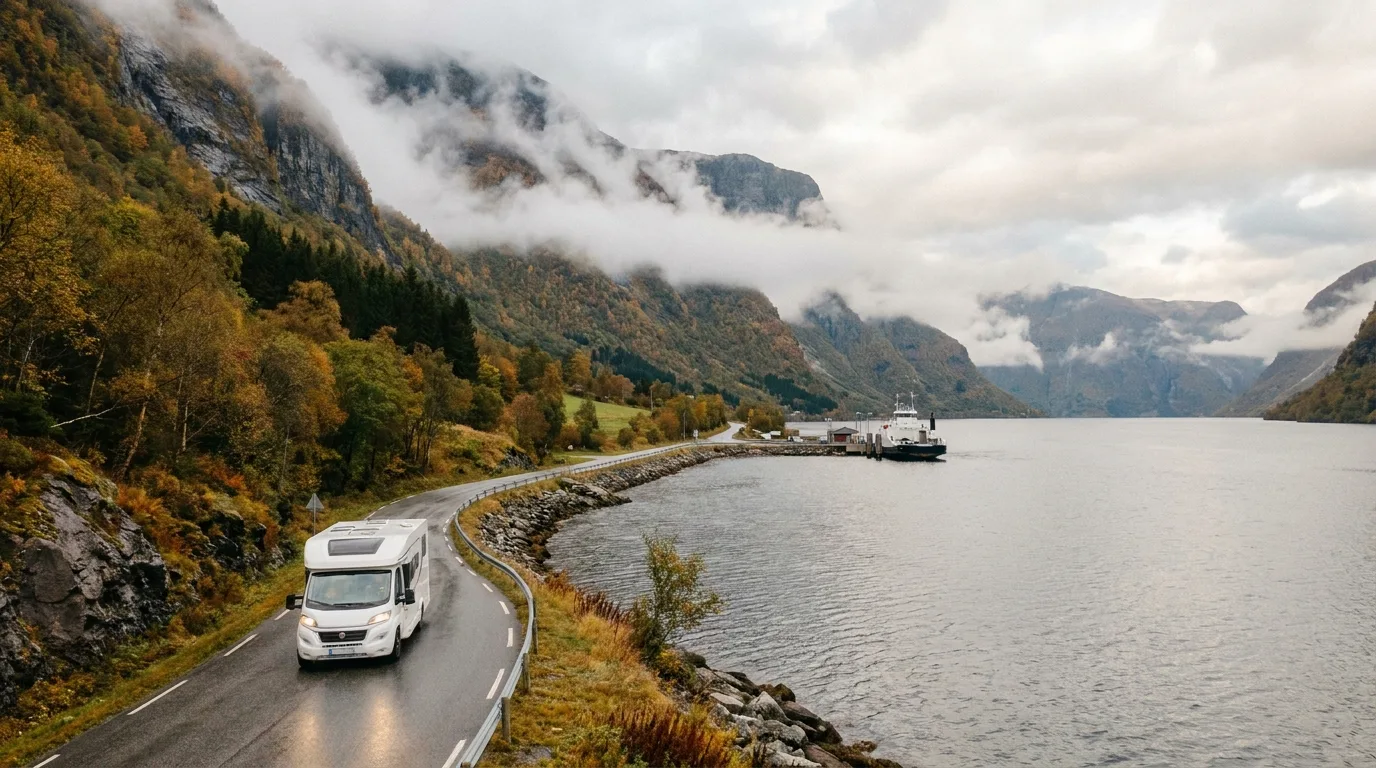
Photo: the car ferry between Eidsdal and Linge, by Mark König via Unsplash.
Frequently asked questions
Matching campervan routes
About the author

Co-founder of Camproads
Bas is co-founder of Camproads. He previously worked in the travel industry on rail and package holidays, and started Camproads on the conviction that a motorhome trip deserves better planning than a list of sights. At Camproads he handles route research and the data behind it: which stages are actually drivable, where you may legally spend the night, and what a trip really costs. He prefers writing about what other articles skip.
Co-founder of Camproads · background in the travel industry · route planning and trip costs