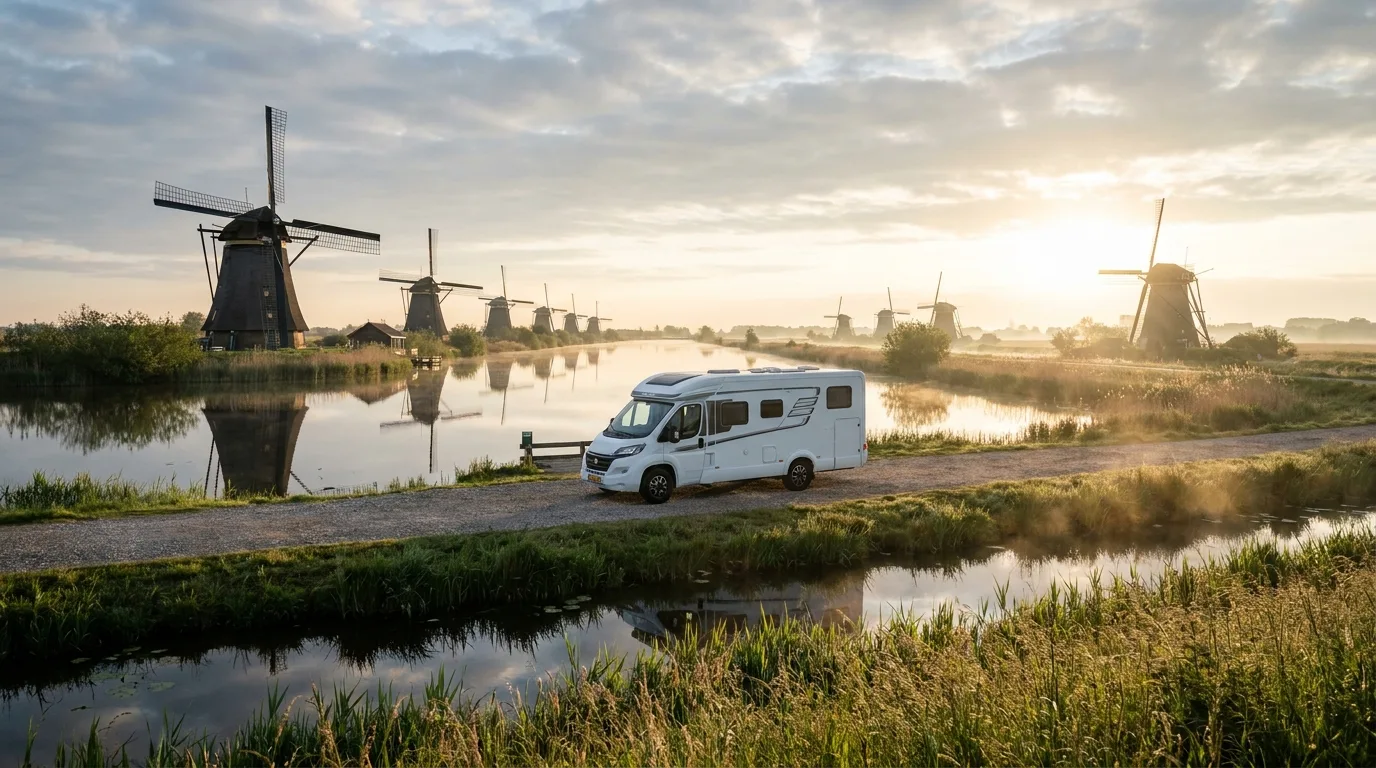
Campervan road trip Water, Windmills & Old Masters - Holland and Flanders by Campervan
    Back

    Water, Windmills & Old Masters - Holland and Flanders by Campervan

    Netherlands
    Belgium

    Take this trip by motorhome

    Save €400–€800 on average vs. a travel agency

    Duration

    x days

    Distance

    0 km

    stops

    0

    Choose a date and duration that fits your preferences

    About this route

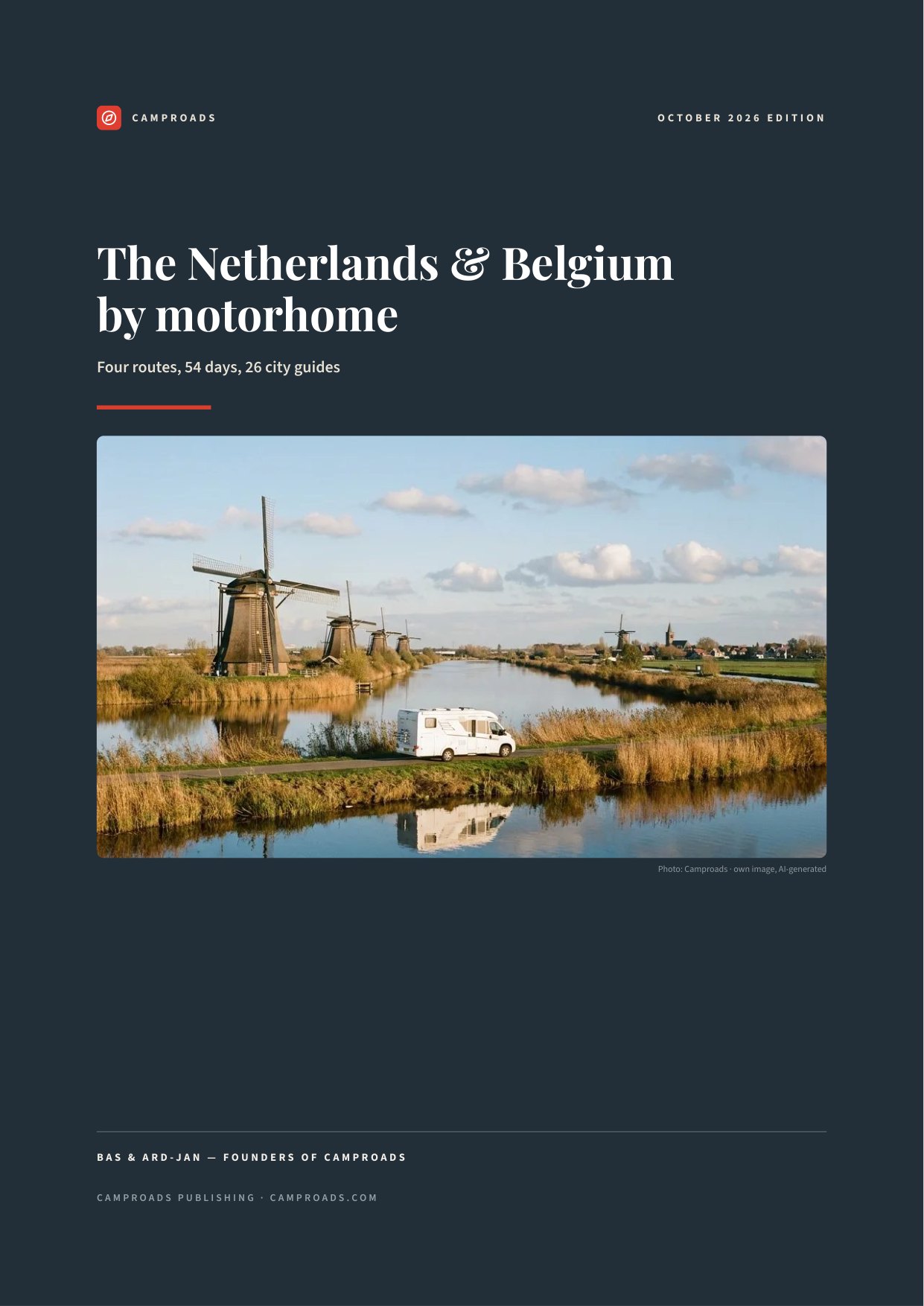
    This loop shows why the Netherlands and Flanders have been turning up in paintings for four centuries. You start in Amsterdam, pass the working paint and oil mills of the Zaanse Schans and cross the bulb fields to the coast, then follow the water south: Vermeer's Delft, the nineteen polder windmills of Kinderdijk on the World Heritage list, and the Delta Works where the Netherlands dug itself in against the sea after the flood of 1953. Across the border wait Bruges, Ghent and Antwerp, three cities you explore on foot while the motorhome stays parked on the edge. The legs are short — rarely more than an hour behind the wheel — so your days go on the places themselves rather than on the road. Expect flat country, a great many cyclists, and historic centres no motorhome belongs in: that is not a limitation but the rhythm of this trip. April to June and September are the finest months; to catch the bulb fields in flower, come between mid-April and early May. Discover all our camper trips through Netherlands. View more camper routes in Belgium.

    Highlights

    • Two nights in Amsterdam, with the motorhome outside the low-emission zone
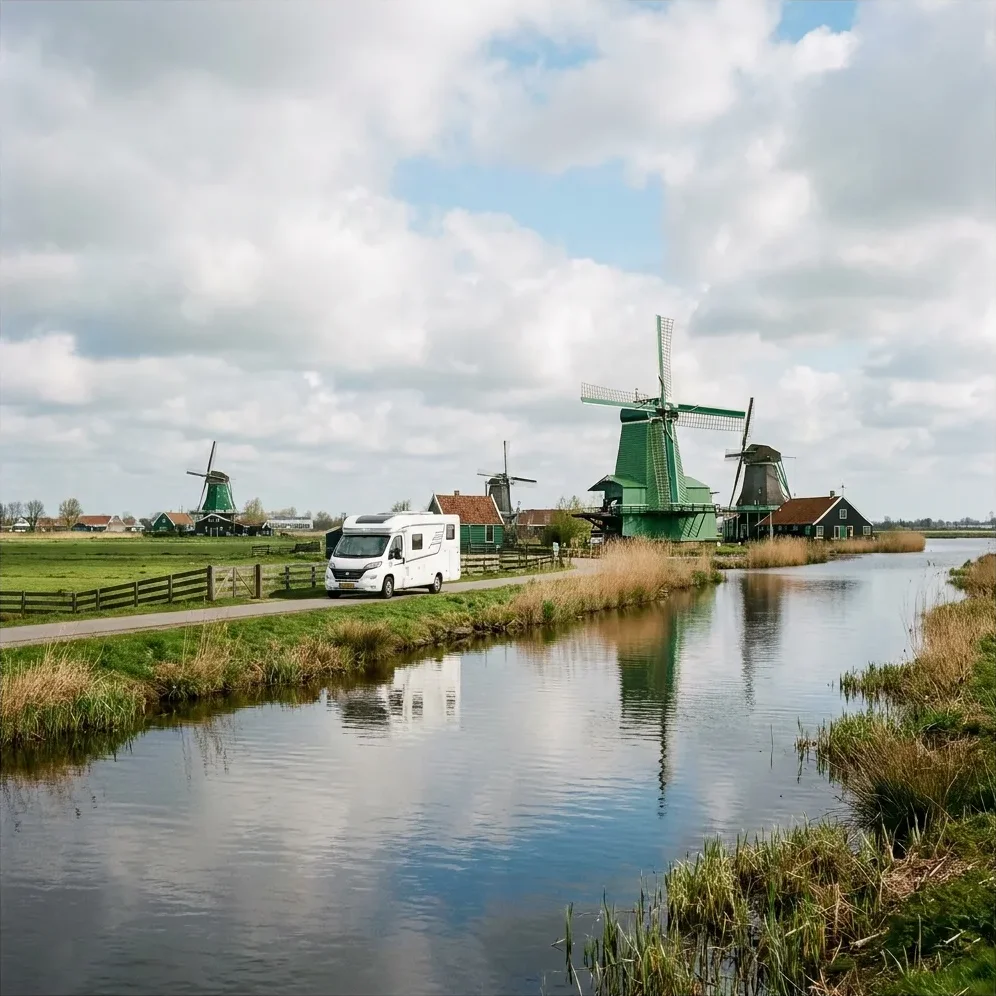
    • Working paint and oil mills at the Zaanse Schans
    • Bulb fields and Keukenhof in spring
    • Vermeer's Delft and the Mauritshuis in The Hague
    • Nineteen polder windmills at Kinderdijk, a World Heritage site
    • Driving the N57 across the Oosterschelde storm surge barrier
    • Two nights in Bruges, plus Ghent and Antwerp
    • Rarely more than an hour behind the wheel each day

    The route
    Camper trip to Amsterdam, Netherlands

    Stop 1

    First stop

    Amsterdam

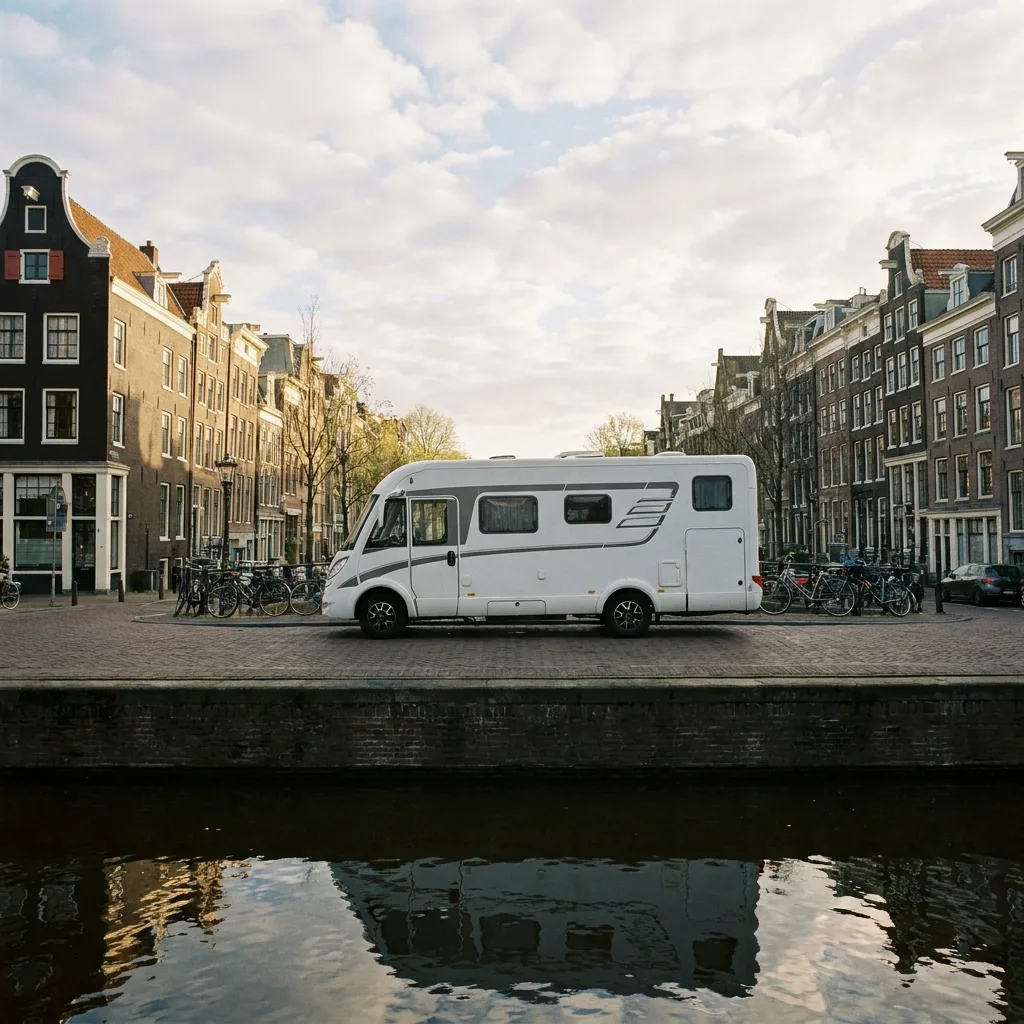
    The Dutch capital stands on wooden piles driven into peat, and its shape comes from the seventeenth-century ring of canals that now carries World Heritage status. Behind the gables of the Herengracht and Keizersgracht sit museums of the first rank: the Rijksmuseum with Rembrandt's Night Watch, the Van Gogh Museum and the Anne Frank House on the Prinsengracht. When the crowds get too much, walk into the Jordaan or take one of the free ferries across the IJ to Amsterdam-Noord. Two nights is the minimum for a museum, a canal cruise and an evening in a brown café. You cannot drive a motorhome into the old centre: the quaysides are narrow, cyclists have priority everywhere and the car parks are too low. The low-emission zone also requires a diesel engine to meet at least Euro 5. Park on the edge of the city and travel in by tram or train.

    Canal ring
    Rijksmuseum
    Anne Frank House
    Waypoints en route to Zaanse Schans1 stop
    Camper trip to Zaanse Schans, Netherlands

    Stop 2

    Zaanse Schans

    The Zaanse Schans is a hamlet on the river Zaan where historic timber houses, warehouses and mills from across the region were brought together from the 1960s onwards. Several of the windmills still work for a living: one grinds pigment for paint, another presses oil, a third saws timber, and inside you can watch the shafts and grinding stones turn. Around them stand a clog maker, a cheese farm and a pewter foundry, and from the dyke you look across the water at a row of green gables. The site itself is free to walk through, while the mills and workshops charge admission. Come early in the morning or towards closing time, because in between the coaches from Amsterdam fill the paths. Motorhomes are not allowed on the site's car park; there is a motorhome stopover in Zaandam a few kilometres away.

    Working windmills
    Clog workshop
    Green wooden houses
    21 kmfrom Amsterdam
    25 min
    Waypoints en route to The Hague & Scheveningen2 stops
    Camper trip to The Hague & Scheveningen, Netherlands

    Stop 3

    The Hague & Scheveningen

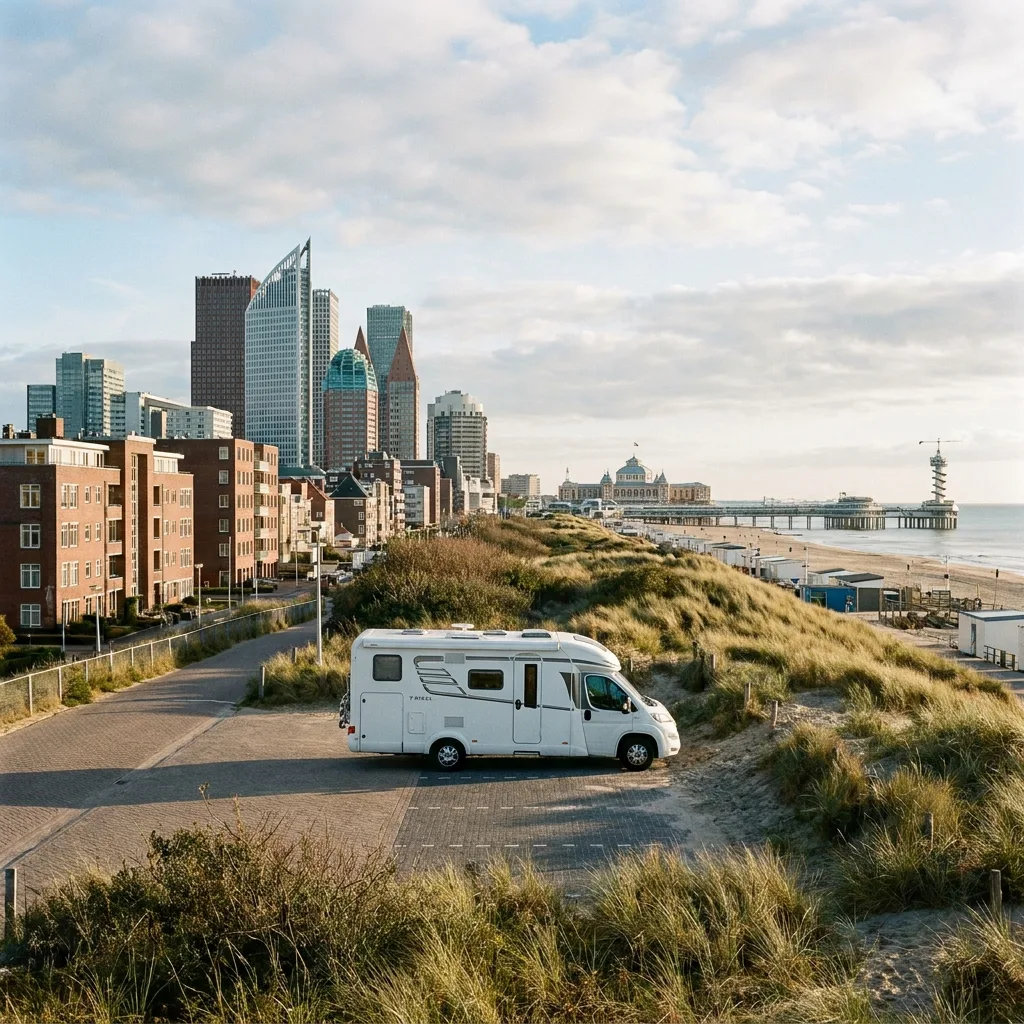
    The Hague runs the country without ever having been its capital: government and parliament sit at the Binnenhof, a medieval courtyard complex beside a pond, and the International Court of Justice meets in the Peace Palace. Next door the Mauritshuis, a compact town palace, holds work by Vermeer, Rembrandt and Fabritius, including Girl with a Pearl Earring. Escher in Het Paleis fills a former royal winter palace with impossible staircases, and Madurodam lays out the whole country at 1:25 scale. Behind the dunes lies Scheveningen, with a wide sand beach, a promenade and a pier built out over the water. Trams link the centre with the seafront, which is the sensible way to arrive. Note the low-emission zone: diesel motorhomes need at least Euro 4 here. The seafront is packed in July and August, while May, June and September are noticeably calmer.

    Mauritshuis
    Binnenhof
    pier over the sea
    70 kmfrom Zaanse Schans
    56 min
    Camper trip to Delft, Netherlands

    Stop 4

    Delft

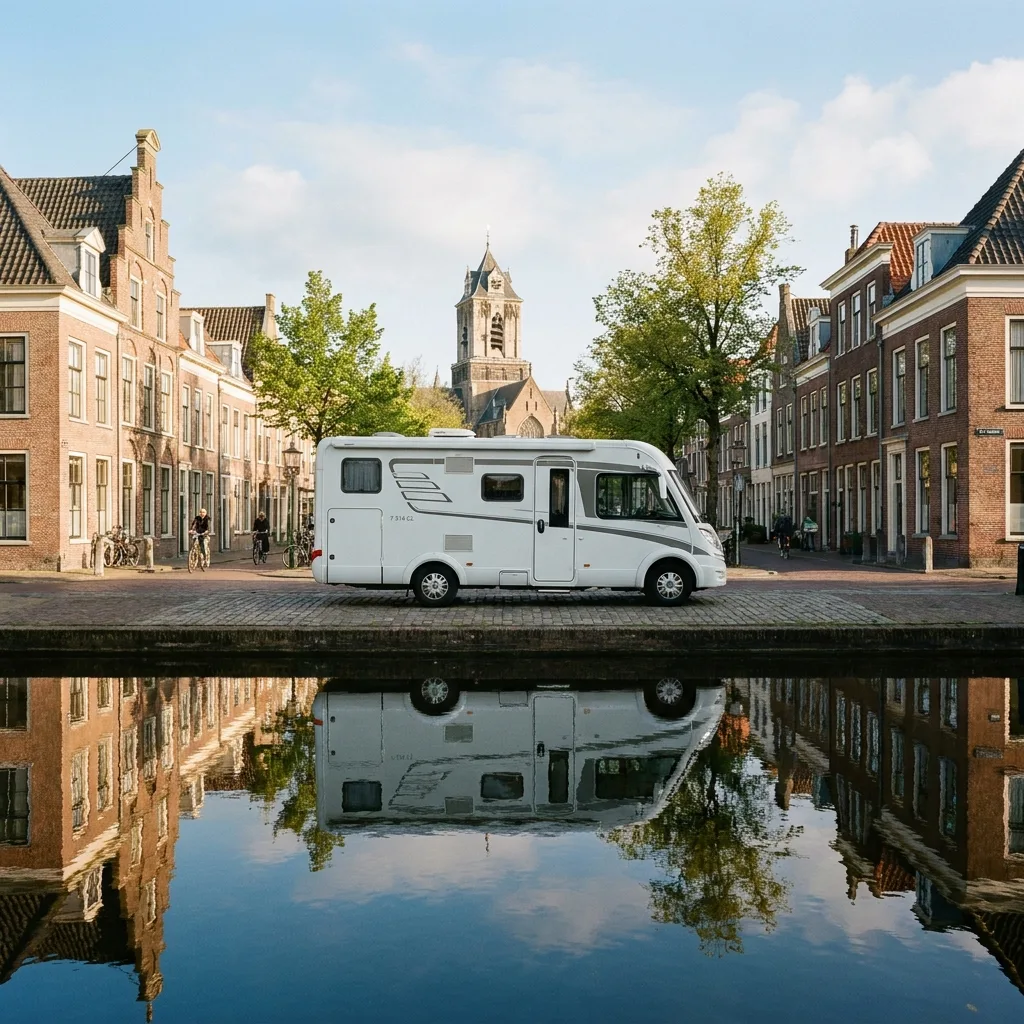
    Two things shape Delft: Vermeer, who painted his View of Delft here, and the blue-and-white pottery that has been hand-painted since the seventeenth century and is still made that way at Royal Delft. On the Markt the late-Gothic town hall faces the Nieuwe Kerk, where William of Orange and later members of the royal house lie in the crypt and where the tower can be climbed. In the Prinsenhof, a former convent, William of Orange was shot dead in 1584; the bullet holes are still in the wall beside the staircase. A few streets away the Oude Kerk leans visibly, sunk into the peat. Delft is where the House of Orange is buried, so state funerals still come to this square. The town has no low-emission zone, but the canal lanes are far too tight for a large vehicle: park outside the ring of moats and walk into the centre.

    Nieuwe Kerk
    Prinsenhof
    blue-and-white pottery
    13 kmfrom The Hague & Scheveningen
    20 min
    Waypoints en route to Kinderdijk1 stop
    Camper trip to Kinderdijk, Netherlands

    Stop 5

    Kinderdijk

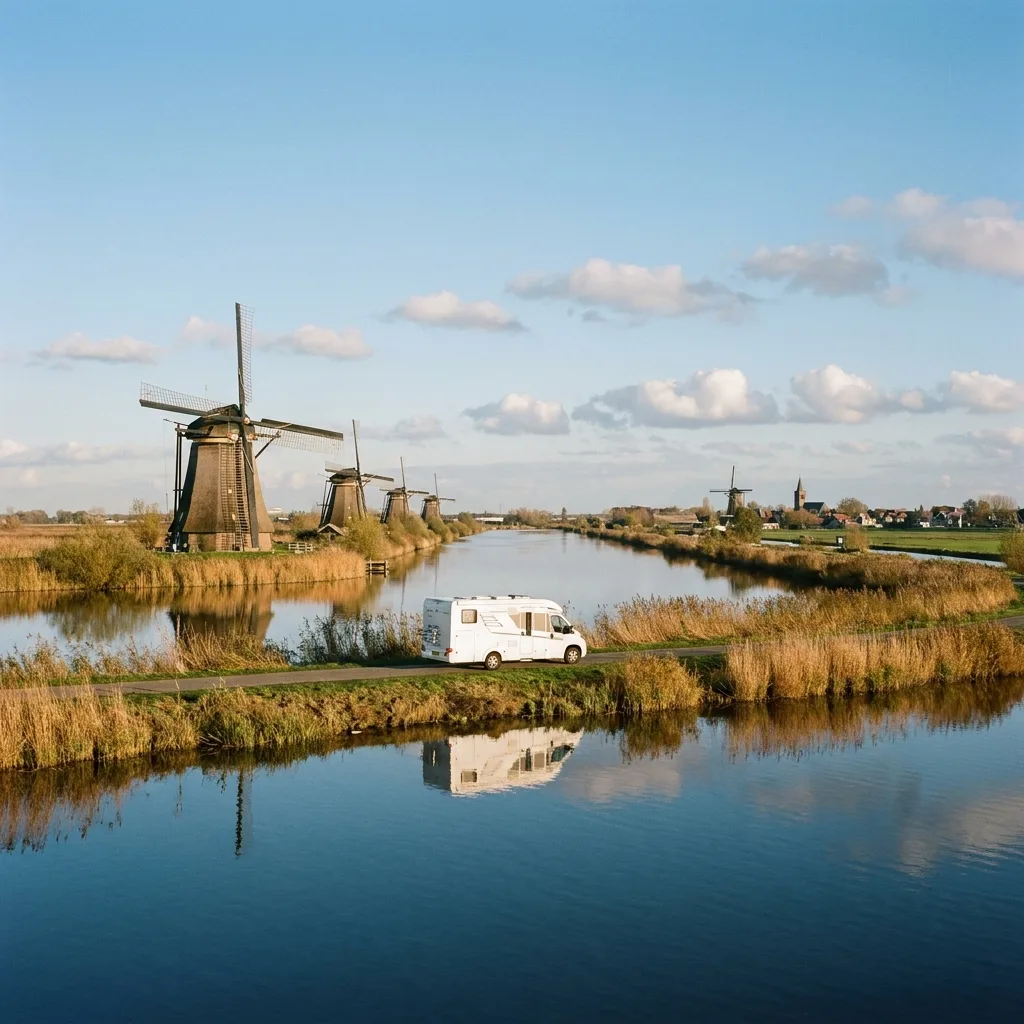
    Nineteen windmills dating from around 1740 stand in two long lines across the Alblasserwaard polder, close to where the rivers Lek and Noord meet. They were built to lift surplus water out of the sinking peat into a holding basin, and that interplay of mills, sluices and pumping stations put the site on the UNESCO World Heritage list in 1997. Two of the mills are furnished as museums, complete with the box beds and tools of the milling families who lived in them into the twentieth century. Footpaths and cycle paths run along the dikes beside the water, and boats work their way between the mills. Motorhomes may not park in the village at any time of year; there is designated daytime parking at the edge and a motorhome site in Alblasserdam. Early morning and evening are the quiet hours.

    Nineteen polder windmills
    museum mill
    boat between the mills
    42 kmfrom Delft
    44 min

    Want to actually take this trip?

    We put together the complete package for you — motorhome, ferry, campsites — in one personal email.
    Save €400–€800 on average vs. travel agency
    Waypoints en route to Middelburg & Veere1 stop
    Camper trip to Middelburg & Veere, Netherlands

    Stop 6

    Middelburg & Veere

    In the seventeenth century Middelburg was the second trading city of the Dutch Republic and home to the Zeeland chamber of the East India Company, which still shows in the late-Gothic town hall on the Markt with its row of statues of counts and countesses. The abbey complex next to it encloses three courtyards and carries the Lange Jan, a ninety-metre tower whose two hundred and seven steps lead to a view across the whole of Walcheren. Much of the old centre burned out in May 1940 and was rebuilt in period style afterwards. A short drive away lies Veere, once the staple port for Scottish wool and now a small harbour town on the Veerse Meer, with the Schotse Huizen on the quay, a church far too big for the place and the Campveerse Toren on the corner. The Veerse Meer behind it is itself a Delta Works product, cut off from the sea by a dam in 1961. Walcheren fills up in July and August; May, June and September are calmer.

    Lange Jan tower
    Schotse Huizen
    Campveerse Toren
    126 kmfrom Kinderdijk
    1u 33m
    Camper trip to Bruges, Belgium

    Stop 7

    Bruges

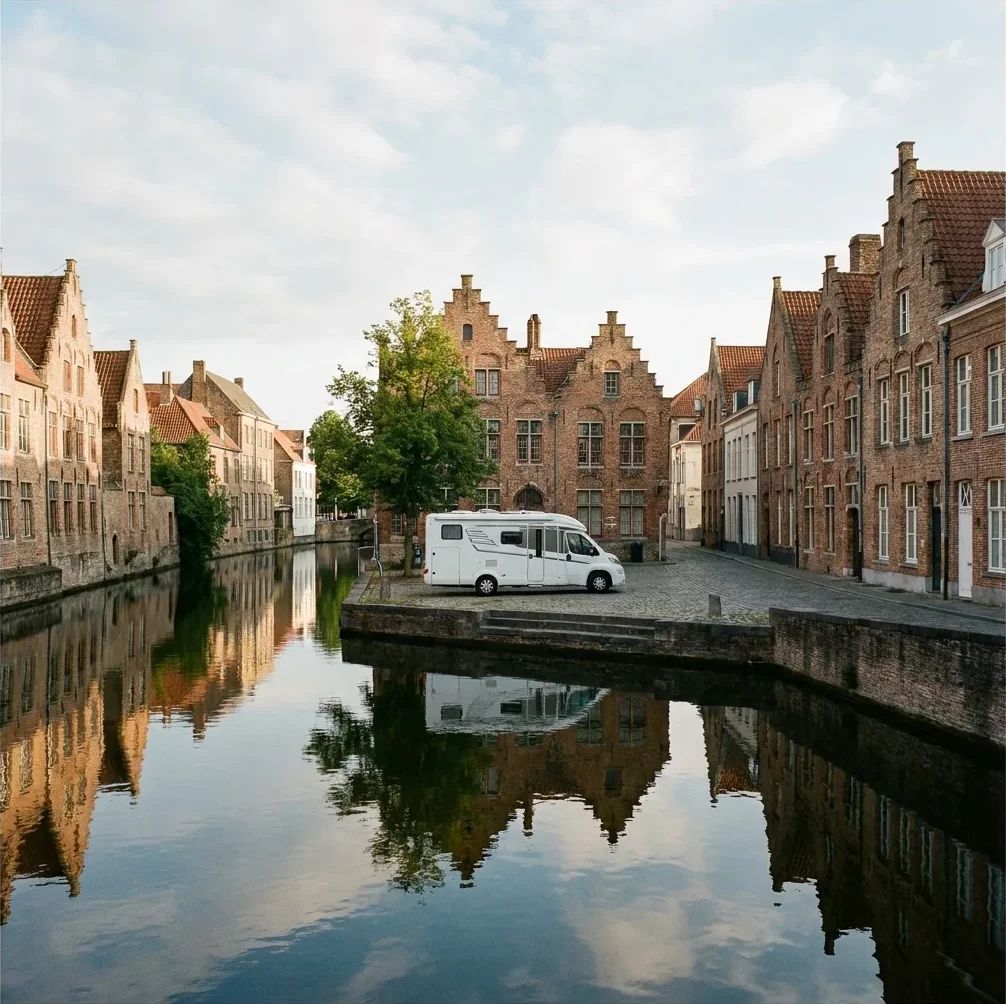
    The historic centre of Bruges is on the World Heritage list and has stayed largely medieval, because once its sea channel silted up the city fell quiet for centuries and nobody rebuilt it. On the Markt stands the Belfry, eighty-three metres tall, with 366 steps climbing past the carillon to a view over rooftops and water. The canals cut straight through the city and look best from the water itself, with boats leaving from landing stages scattered around the centre. The Groeningemuseum holds the Flemish Primitives, among them Jan van Eyck and Hans Memling, while the Onze-Lieve-Vrouwekerk keeps Michelangelo's Madonna and Child, the only sculpture of his to leave Italy in his lifetime. The Begijnhof and the Minnewater are quietest early in the morning. Vehicles over 3.5 tonnes may not enter the old centre, and sleeping in a vehicle on the street is banned here.

    Belfry tower
    Canal boat trip
    Michelangelo's Madonna
    98 kmfrom Middelburg & Veere
    1u 25m
    Camper trip to Ghent, Belgium

    Stop 8

    Ghent

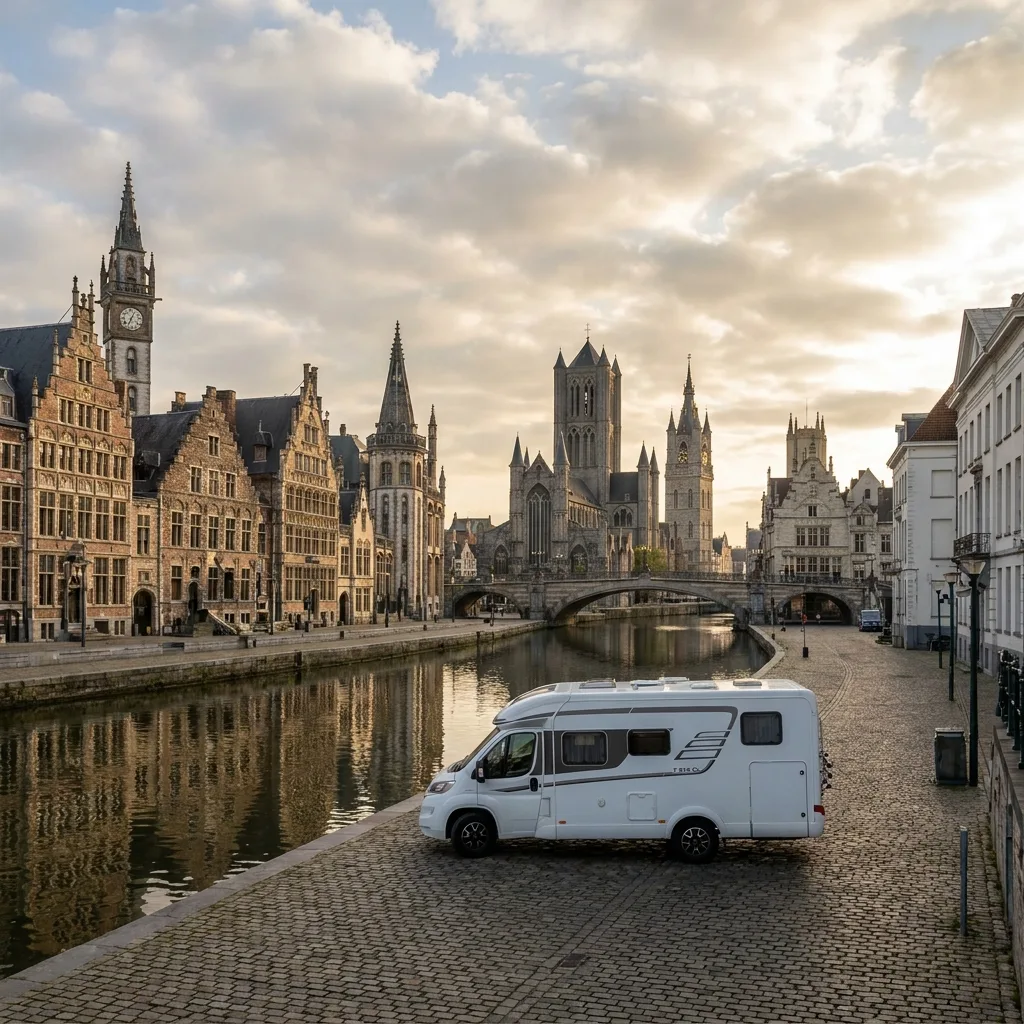
    In the Middle Ages Ghent was the largest city north of the Alps after Paris, and you can still read that in the Graslei and the Korenlei, two quays of guild houses facing each other across the Leie. The Gravensteen, the moated castle of the counts of Flanders, sits right in the middle of town and can be climbed inside all the way to the wall walk. Sint-Baafskathedraal holds the Ghent Altarpiece by the Van Eyck brothers, a polyptych finished in 1432 and now shown in a separate climate-controlled room. Unlike Bruges, Ghent is not a museum town but a working university city: the cafés are full of students and much of the centre is closed to through traffic. Ghent has a low-emission zone, and foreign number plates must register in advance, free of charge, even when the vehicle is admitted without restriction. Sleeping in a vehicle on the street is not allowed.

    Graslei quay
    Gravensteen castle
    Mystic Lamb altarpiece
    49 kmfrom Bruges
    47 min
    Camper trip to Antwerp, Belgium

    Stop 9

    Antwerp

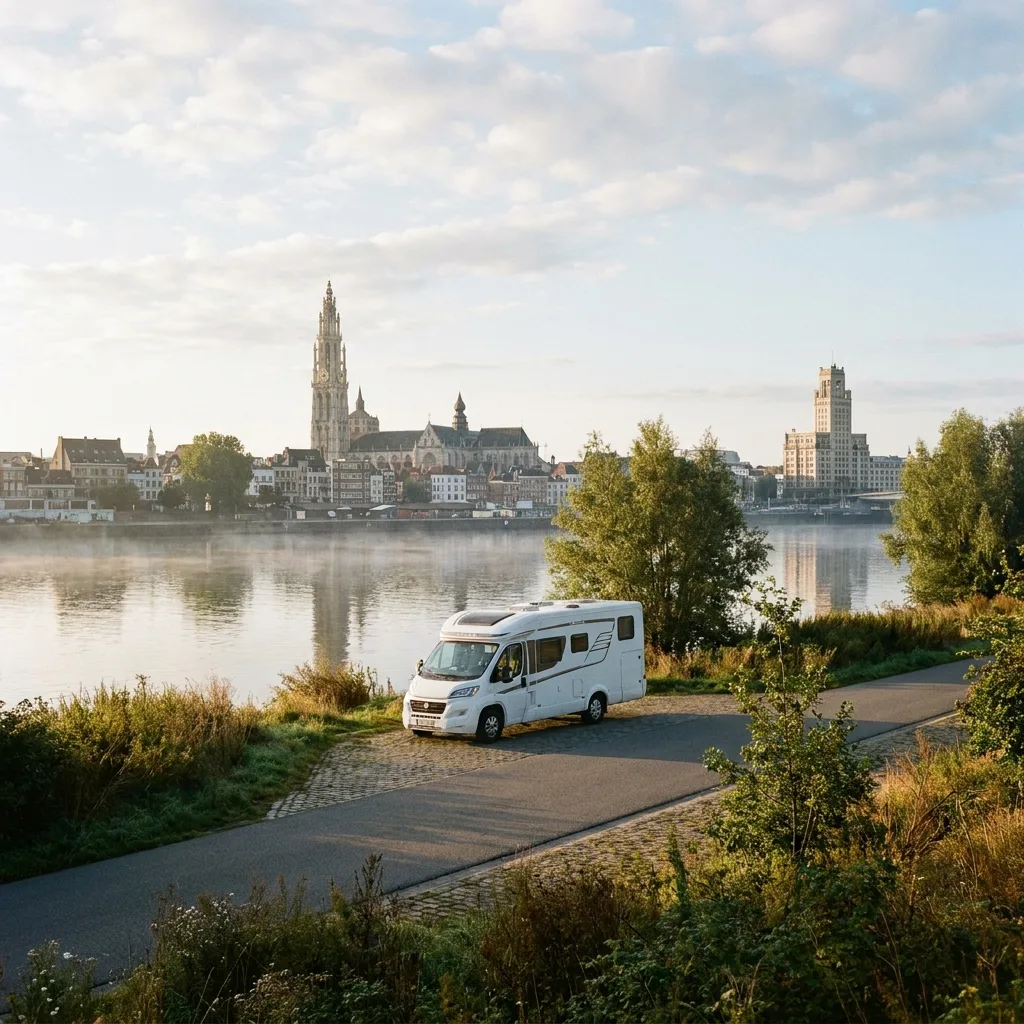
    Antwerp puts a medieval core next to the second largest port in Europe, and the clash of scales is part of its appeal. The Cathedral of Our Lady towers over the Grote Markt and holds four Rubens altarpieces, among them the Raising and the Descent from the Cross; a few streets away stands the house where he lived, with his studio and walled garden. On the Scheldt the MAS museum runs a chain of escalators up through the building to a free roof terrace looking over city and docks. The Plantin-Moretus museum keeps the two oldest surviving printing presses in the world, and around Central Station, itself a cathedral of marble and glass, lie the diamond quarter and the shopping streets where Antwerp fashion made its name. Two nights is tight. Do not drive into the centre: a low-emission zone applies, foreign number plates must register in advance free of charge, and sleeping on the street is banned.

    Cathedral of Our Lady
    Rubens House
    Central Station
    60 kmfrom Ghent
    57 min
    Camper trip to Amsterdam, Netherlands

    Stop 10

    End

    Amsterdam

    The Dutch capital stands on wooden piles driven into peat, and its shape comes from the seventeenth-century ring of canals that now carries World Heritage status. Behind the gables of the Herengracht and Keizersgracht sit museums of the first rank: the Rijksmuseum with Rembrandt's Night Watch, the Van Gogh Museum and the Anne Frank House on the Prinsengracht. When the crowds get too much, walk into the Jordaan or take one of the free ferries across the IJ to Amsterdam-Noord. Two nights is the minimum for a museum, a canal cruise and an evening in a brown café. You cannot drive a motorhome into the old centre: the quaysides are narrow, cyclists have priority everywhere and the car parks are too low. The low-emission zone also requires a diesel engine to meet at least Euro 5. Park on the edge of the city and travel in by tram or train.

    Canal ring
    Rijksmuseum
    Anne Frank House
    162 kmfrom Antwerp
    2u 18m
    Travelers save €400–€800 on average vs. a travel agency

    Ready to hit the road?

    We'll email you a personal travel proposal within 24 hours — motorhome, route and full cost overview included. Save €400–€800 on average vs. a travel agency.

    No packages, no middlemen. Learn how it works

    Camproads gave me a lot of inspiration for our campervan trip. The routes are beautiful, with a good balance of nature and city life, and the route generator made planning super easy. It's also really handy that there are so many good camping options at the locations, and that you can easily find the campervan that suits your needs and compare prices. This way, we can plan everything ourselves and book the campervan directly with the rental company. That's much cheaper than an organized trip!

    Michiel van de Bunt

    February 2026

    What a difference from how I used to plan trips. Through Camproads, I put together a complete campervan trip in just a few minutes. It's so easy to use, and you can customize everything to your liking. The ability to choose your travel pace makes it even more enjoyable, especially now that we're traveling with a baby for the first time.

    Alieke Zelhorst

    February 2026

    We respect your privacy

    We use cookies to provide you with the best experience. You can choose which categories of cookies you accept.

    By continuing to use Camproads.com you agree to our privacy policy and our terms and conditions.