Key takeaways
- A standard car license (EU Cat B) typically limits you to a 3,500 kg maximum authorised mass—including payload, water, gas, and passengers.
- Payload isn't always explicitly listed in brochures; calculate it yourself by subtracting the Mass in Running Order (MIRO) from the Maximum Authorised Mass (MAM).
- A full 100-litre fresh water tank adds 100 kg to your weight.
- Overloading can result in fines and may affect your insurance coverage in the event of an accident.
- Rental motorhomes, especially larger models, often have a lower payload than you might expect.
There’s a moment familiar to many first-time motorhome trips. You're parked on the driveway, the vehicle is loaded, and someone asks aloud: are we actually within the legal weight limit?
More often than not, the answer is no.
The two numbers that matter
Your vehicle's registration documents contain two key figures that define your entire luggage capacity.
The Maximum Authorised Mass (MAM) is the absolute upper limit. For drivers with a standard car license (Category B in the EU), this is typically 3,500 kg (approx. 7,716 lbs). That’s not 3,500 kg of luggage — it’s the total weight including the vehicle itself, fuel, water, gas, passengers, and everything you bring along. UK drivers who passed their test before 1997 may have entitlements to drive heavier vehicles, but it's crucial to check your own license.
The Mass in Running Order (MIRO) is what the motorhome weighs when empty. This figure has increased significantly in recent years as motorhomes have become more luxurious, safer, and better insulated.
The difference between these two is your payload. On modern motorhomes and campervans, this is often just three to five hundred kilograms. Sometimes less.
What uses up your payload
Four hundred kilograms sounds like a lot. Let's do the maths.
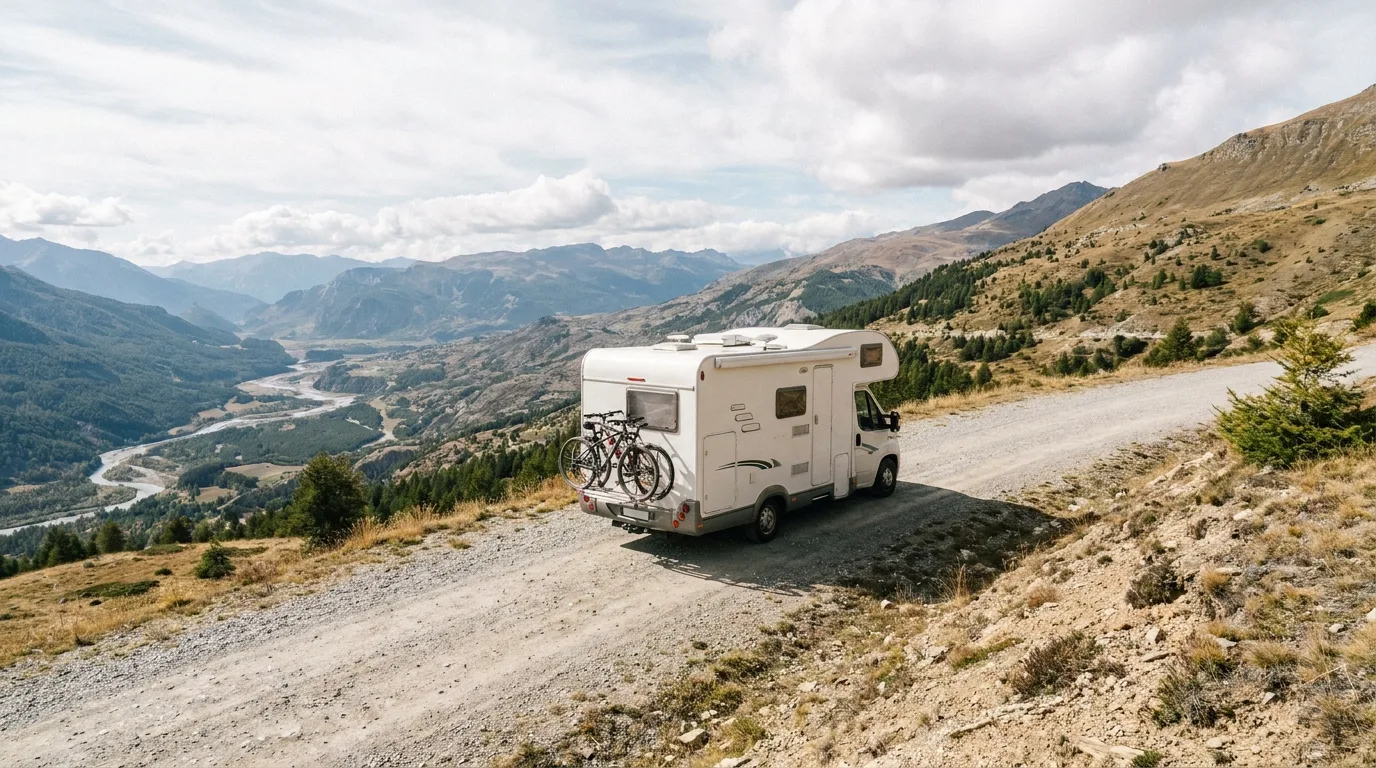
Two adults can easily weigh one hundred and fifty kilograms. A full 100-litre fresh water tank is another hundred kilos — water weighs exactly one kilogram per litre, a non-negotiable fact. Two gas bottles with their holder add around thirty kilos. Two bicycles on a rack: forty to fifty kilos, and a single e-bike can weigh twenty to twenty-five kilos on its own.
That brings you to three hundred kilos, and you haven't even packed clothes, food, shoes, bedding, camping chairs, tools, or toys yet.
If you're driving an older, heavier motorhome with a MIRO over three thousand kilos, you might have so little payload left that a full tank of diesel, some water, and a dog will max you out.
Why it's not just a formality
Overloading isn't a mere paper violation. It changes how the vehicle handles and brakes, puts more stress on the axles than they were designed for, and increases your stopping distance — especially on mountain passes where you need control the most.
Furthermore, a weighbridge check is final. Fines can be steep, and in case of an accident, being overloaded can raise serious questions about your insurance coverage.
What you can do about it
Calculate beforehand. Find the MAM and MIRO on your vehicle's registration documents, subtract the latter from the former, and then subtract the weight of all passengers. What's left is your true payload.
Travel with less water. This is your biggest win. You don't need a full tank to get to your destination; you can fill up upon arrival. Remember that your wastewater tank and toilet cassette also count towards the total weight.
Don't count on a vehicle upgrade. Some motorhomes can be technically 'up-plated' to a higher MAM. However, this doesn't solve the problem if you're on a standard Category B license: for vehicles over 3,500 kg, you need a C1 license, regardless of the vehicle's technical rating. Up-plating is a solution for those who already have the appropriate license, not for those wanting to pack more.
Get it weighed. Using a public weighbridge is inexpensive and provides a certainty no brochure can offer.
Be critical of bikes. A bike rack on the back is also unfavourably positioned, as the weight hangs far behind the rear axle, which can affect stability.
Check carefully when renting. Rental motorhomes, especially larger models with fixed beds and extensive amenities, often have a tighter payload than you'd expect. Ask about it before you book, not when you're picking it up.
The conversation nobody is having
It's striking how rarely payload comes up in conversations about choosing a motorhome. People focus on the layout, the bed, the kitchen, the looks. The payload only becomes a concern when the storage lockers are already full.
Yet, it should be a primary factor in your decision. A more compact motorhome with a higher payload can be more practical for a family than a spacious one with a 300 kg margin. And if you're a couple who travels light, that same margin might be perfectly adequate.
It’s not about taking less than you want. It’s about knowing which motorhome or campervan fits your travel style before you commit — because that's the choice the rest of your journey depends on.
Frequently asked questions
About the author

Co-founder of Camproads
Ard-Jan is co-founder of Camproads. He works on the substance of the routes: which stops are worth the detour, what order makes a trip flow, and how to divide a stage so there is time left to actually stay somewhere. He writes about trip preparation, vehicle types and the choices you make before you leave.
Co-founder of Camproads · route composition and trip preparation